Category Archives: huchuy qosqo

INFORMACION OF HUCHUY QOSQO – CUSCO – PERU

Where is Huchuy Qosqo located?

Huchuy Qosqo is located in the peasant community of the same name, just under 5 km from the city of Calca in the department of Cusco, in the Sacred Valley of the Incas; exactly at a summit at 570 m. over the Urubamba river basin (Vilcanota). The Huchuy Qosqo route is very beautiful; walking its trails will allow you to visit some Andean communities, archaeological centers and enjoy beautiful landscapes. Many people take advantage of visiting Huchuy Qosqo on their trip to Machu Picchu. HUCHUY QOSQO TREK TO MACHU PICCHU
What does Huchuy Qosqo mean?

Huchuy Qosqo means “Little Cusco”, but it also has other names; one would be Qaqyaxaqixawana and the other Qaqyaqhawana, this means “from where the rays are observed”; and without a doubt it is a good name since being 800 meters above the Sacred Valley of the Incas, gives you the opportunity to see the dramatic light and sound show, at the moment when lightning and thunder descend from the sky to crash into the ground. Others say that the site was probably known in Inca times as “Caquia Jaquijahuana”.

Huchuy Qosqo Archaeological Complex (Qaqyaqawana)

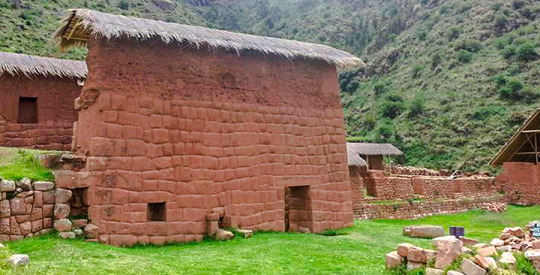
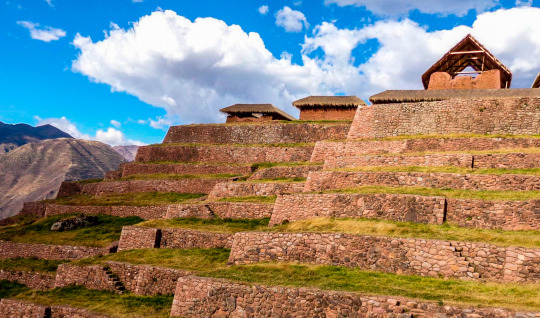
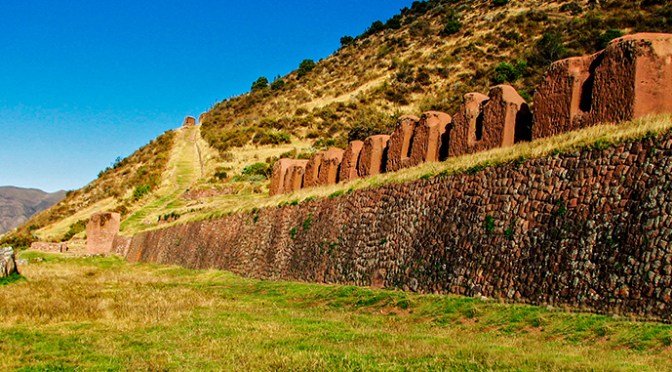
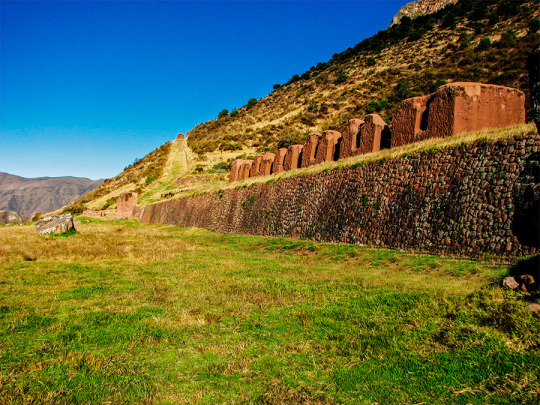
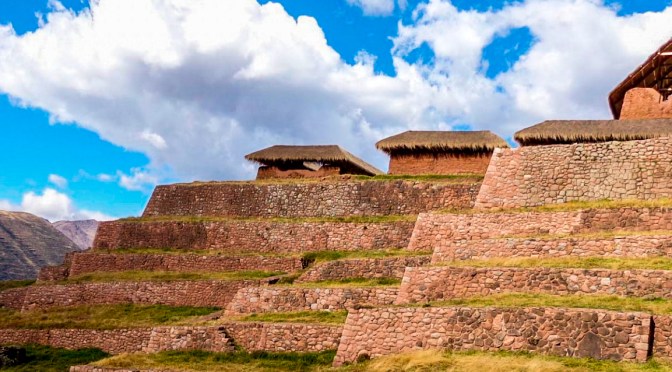
The compound located in Huchuy Qosqo, is called Qaqyaqawana; Quechua name that refers to the place where the lightning is seen. This archaeological site is located in the upper third of the mountain called Qaqya (thunder), and exhibits one of the most impressive topographical modification works through the use of andenería, modulating the edges of precipices and vertical ravines over the Vilcanota Valley, culminating on platforms that were used as ceremonial esplanades, around which several architectural structures made of stone and adobe can still be found standing. Materials used and worked with great judgment, achieving a fine finish.

In addition, the structures of the enclosure are distributed in such a way that they architecturally resemble the city of Cusco; it is for this reason that at the beginning of the 20th century it receives the name of Huchuy Qosqo (small Cusco). One of the most outstanding characteristics of this archaeological site is the use of lithic material combined with adobe and clay. This shows the knowledge and mastery of the different construction materials, used with high technology, especially adobe; The centuries-old walls built of this material still defy the strong inclement weather of the area, seismic movements and of course the passage of time.

INFORMATION OF HUCHUY QOSQO TREK
 

INFORMATION OF THE ARCHAEOLOGICAL COMPLEX OF HUCHUY QOSQO

Description

This complex is the most important archaeological center in the Urubamba valley, after Ollantaytambo and Pisac. The ruins are impressive, although the conservation of the site is inferior to that of Ollantaytambo or Pisac, because they are older.

But unlike the aforementioned places, Huchuy Qosqo has a peculiar architecture: the buildings have been built on polished stone bases with a fine finish, with clay plaster (they are the best preserved parts) and the highest floors are made of adobe. INFORMATION OF HUCHUY QOSQO TREK

A kallanka (rectangular enclosure that could measure up to 70 meters long and that were important state centers where Inca officials stayed) is observed, at least 40 to 50 meters long. Also a remarkable building with two stone floors and an upper one of adobe. There are also large terraces, a very large plaza and a large Inca gate through which a well-preserved path leads from Tambomachay.

The Hispanic chronicles refer that Huchuy Qosqo (probably a site known in Inca times as Caquia Jaquijahuana) was the work and preferred place of the Inca Wiracocha. To this, Maria Rostworoski adds, in her work “History of the Tahuantinsuyo”, that this sovereign established the conquest over the towns of the Urubamba valley and that he chose as his successor his Inca son Urco who, dizzy with power and vices, proved to be totally incapable of ruling. Inca royalty was very confused by this choice and they tried to conspire to impose on another Wiracocha son, Prince Cusi Yupanqui. Social unrest and tension increased every day and to make matters worse, the darkest night fell on Cuzco: the Chancas reached the gates of the capital and were ready to destroy it. It is the year of 1438. Wiracocha abandons the city to his fate and, accompanied by his son Inca Urco, takes refuge in his palaces in the Urubamba Valley, among which was Huchuy Qosqo.

After the Spanish conquest, Gonzalo Pizarro found the mummy that supposedly belonged to the Inca Wiracocha here and ordered to burn it. The descendants of the Inca kept the ashes in a jar that many years later the chronicler Polo de Ondegardo would discover.

Characteristics of the visit

It is possible to visit Huchuy Qosqo in two ways, the first walking from Cusco and Tambomachay along the Inca trail. The other way is going up from the Sacred Valley after crossing the Wilcamayo river (today Vilcanota).

Schedule

Hours (all year)Free access