Category Archives: Sin categoría

Choquequirao Archaeological Site and its twelve sectors

Sectors of Choquequirao

In sector I, the sector of the plaza and temple, hanan area, located to the north and which is the highest part, there are five floor buildings, located on terraces of different levels. It is possible that they served as the residence of the priests. Higher up, there is another smaller plaza where two warehouse buildings (qolqas) and three other long residential buildings are located.

(kallankas). A wall with a main channel of water collected from the Ch’unchumayo stream also enters here, supplying the archaeological site and descending, like a spinal column, organizing the arrangement of the buildings.

In sector II, hanan zone, there are the deposits or qolqampatas divided into warehouses with internal subdivisions with quincha partitions; in another space, within this subsector, there are small ceremonial platforms (16 platforms), crossed by an alternate channel that takes advantage of the waters of the main channel.

CHOQUEQUIRAO TREK INFORMATION.
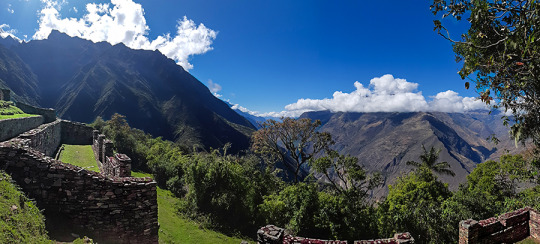
Sector III, which appears to be the main square or Hauqaypata, is located between the upper (hanan) and lower (hurin) sectors, on the filling of a platform. On the extreme sides of this square there are buildings with one and two levels. In the north there is a kallanka (building) for ceremonial use — Sunturwasi — with low niches (kind of chapels); To the east are two-story buildings with walls that support gabled roofs. They have two facades, one for entering the main plaza and the other that leads to a patio with side accesses. Access to these buildings is through double jamb covers (a double frame). These buildings are separated by a corridor, which highlights the largest building (kallanka) in the city that goes to the side of the backyard and that leaves through a wall to the south side, which is where the platforms in the north sector are located. of the city or llacta.

Sector IV, located in the Hurin or south zone, is a main construction made up of five covers called by Sartiges “triumphal wall” and by Samanez and Zapata “wall of offerings to the ancestors”. The other four, probably, were for ceremonial use and would correspond to an open temple. Behind these covers is a field, where you enter a second level, which is above the covers.

Sector V is the ushnu: a hill cut at its top that forms a ceremonial oval platform and surrounded by a small wall as a fence, which is entered by an entrance that first rises by steps and from where you can see the main square and hanan site. From this place the snow-capped mountains and the Apurímac river are visible.

Sector VI is the Wasi Cancha, located south of the ushnu in the lower part; It is also known as a temple and home of priests. A space of four platforms with zigzag walls is observed, which was used as a ceremonial space. In the first wall it is finished off with a source for water, and the other platforms are accessed with stairs. Below this area of ​​worship you can see a field or space with two enclosures of one and a half floors enclosed by a perimeter wall; from here you can see a good part of the Apurímac river canyon.

Sector VII belongs to the cultivation platforms on the east side. It stands out from the rest, for being wide and wide platforms. It can be entered through walkways from the main square.
The discovery was made in September 2004 within the framework of the «Cadastre and Delimitation (…)
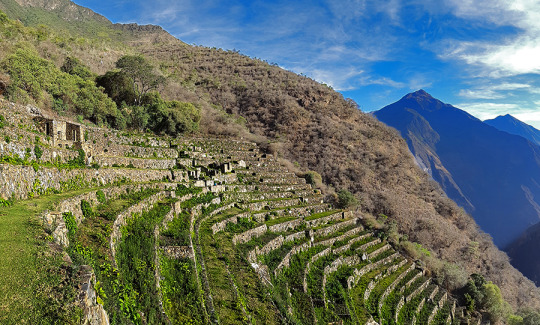
Sector VIII is an area of ​​cultivation platforms, located on the west side, with eighty platforms, divided into plots and water channels that descend from the main square. Here were the famous “Llamas del Sol”

The ceramic remains show a multi-ethnic presence of the llacta (even though there has been int (…)
Sector IX is made up of popular houses, also called Pikiwasi, and is where one of the water channels ends. The houses seem to have been for collective and family use, built on artificial platforms, rectangular, square and circular in design, communicating by means of stairs and narrow passageways.

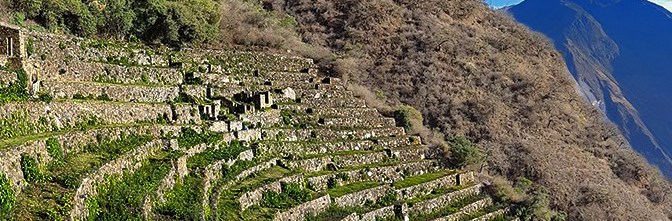
Sector X is made up of the cultivation platforms, the Paraqtepata, made up of 18 platforms and irrigation channels parallel to the stairs.
Sector XI also has cultivation platforms, the Phaqchayoq, made up of 80 wide platforms, the largest of the entire complex and located on the right bank of the Ch’unchumayo stream. There are also small quadrilateral enclosures in the middle of the plots with two-level enclosures, both for ceremonial use and for housing, with three sources for water and irrigation channels.
Sector XII presents cultivation platforms three hours away from Hanan Square, and is made up of 57 platforms with permanent irrigation. In the upper part there are buildings for ceremonial use that occupy the entire width of the platform, a spring pool, a semicircular enclosure where ceramic remains, stone tools and bone remains were found.

MORE INFORMATION OF CHOQUEQUIRAO TREK
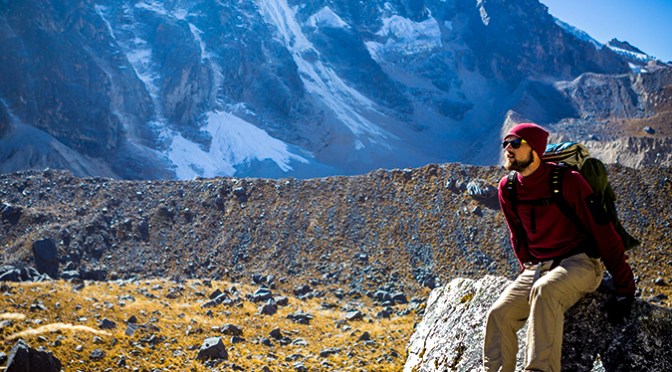
 

All About Salkantay Mountain – Cusco – Peru (part 3)

Location of the snowy mountain of Salkantay:

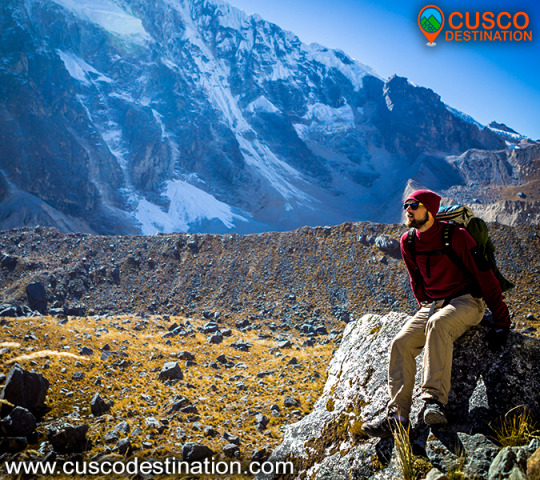
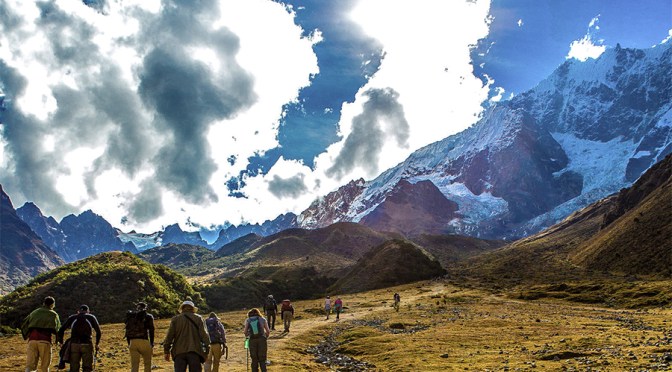
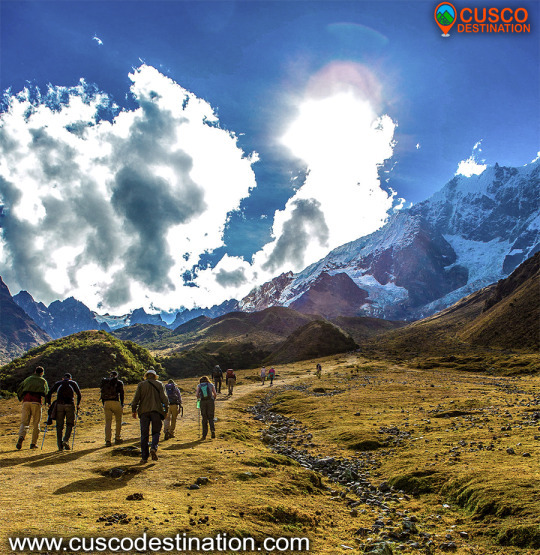
The Salkantay Route, also known as the “New Inca Trail”, is located north of the city of Cusco, following the Cusco – Limatambo – Abancay – Lima road, making a detour between Limatambo and Mollepata.

Salkantay snowy climate:

It is very sunny during the day, but cold at night. The temperature drops below 0 ° C at night during the months of June to September. In the season from December to March it is very rainy so it is not recommended to go on these dates.

The best time to do this trek is during the months of March to September.

Height of the walk to the snowy Salkantay

This hike reaches a height of 4,600 meters above sea level at its highest point is on the slopes of the same snowy Salkantay. Enter Ausangate 5D Snowy Walk to do this little walk.

How to get to the snowy mountain of Salkantay

The buses from Cusco to Mollepata leave very early from 4 am to 5 am and pass through Limatambo, from Mollepata is where the trek to the snowy Salkantay begins, after climbing a step it is possible to have an impressive pyramidal view of Salkantay, one of the mountains most beautiful snowfall of Cusco.

From Mollepata it takes two days to descend to Huayllabamba and join the second day of the Inca Trail.

What you will see along the way

On the way you can see herds of cattle and sheep, orchids, bear with glasses, medicinal plants of the Inca eponca, small variety of birds, fruit trees such as orange, papaya, bananas, and so on.

Note: The eye of the glasses to see it is necessary to have some luck.

recommendations

It is very important for the traveler. Bring your original passport for the respective controls.

RECOMMENDED MONTHS TO TRAVEL

March: (a little rain)
From April to October: (an excellent trip)
From October to November: (a little rain)
December to February: (lots of rain)

SALKANTAY TREK INFORMATION


All About Salkantay Mountain – Cusco – Peru (part 2)

Note: There is, in my opinion, a controversy regarding the paternity of the first ascent of this crest S.E., since it consists in the previous realization of a powerful group of Japanese who achieved the ascent by this route. Unfortunately, the only reference found in this Japanese ascension dates from an Iwa magazine to Yuki, written, of course, in Japanese, so without a translation of the text there is no concrete data.

Humantay Mountain – Salkantay Route To Machu Picchu

The western edge of the Salkantay is a route that remains virgin after years given the complexity of its layout and the distance from the traditional approach points, which requires additional porting based on the dragging of backpacks.

According to the prestigious Pyrenean Louis Audoubert, who ascended to the top by the northern slope in 1977, the west edge is feasible, but it will certainly be a good problem to solve at the Andean level.

This crest was attempted in 1975 by a group of Catalan climbers from Mataró formed by Manuel Punsola and Mitjans, Miquel Sala and Roy, Xavier Varela and Pinart, Ramón Armengol and Carbó, Antoni Sors and Farre, Antoni Rosa and Olivera and Vicente Aris and Julta .

On August 5, 1975, three members of this expedition approached the edge by an additional buttress of the northern slope that had been previously recognized. They go up for a good part of the day until they reach a point with two possibilities that seem unattainable. The logic was to tackle the ice ridge, something impossible given the lack of material means. The other option would be to flank the slopes of the ridge to look for the hill between the two Salkantay peaks.

At a certain point of this great flanking, which they calculate, it will take them a whole day, they decide to leave due to the large number of avalanches that leave the ridge and that are obviously a first order objective danger. Catalan climbers believe that the difficulties so far have not been important or dangerous, but moving away from the obvious route of the ridge, which would require more human and material equipment, greatly increases the risk.

Coming from Mollepata the first vision we will have of Salkantay is in its overwhelming south face a huge wall that closes the bottom of the valley with its vertical seracs hanging from huge rocky spurs, this wall could not fail to attract the attention of those who try to complicate a little their lives for pure personal satisfaction, so in 1970 a powerful group of Germans from the Munich DAV composed of Walter Welsh, J.Vogt, H.Koebrich, H.Haver and M.Olzowy made a meritorious attempt on the left side of the wall, leaving quite high on the crest that descends to the western summit of Salkantay.

In 1986 an English group led by J.Lowe broke through this hillside attacking the rocky base to the right of the German attempt of the 1970s. The snow zone continued a slight diagonal to the right until it reached the eastern peak of the mountain.

On June 15, 1978, a powerful Slovenian expedition of the Planinska Zveza, composed of Libor Anderle, Zoran Breslin, Marjan Brisar, Edi Torkar, Jure Zvan and Jure Ulcar, accompanied by Dr. Borut Pirc and Matjaz Derzaj as coordinator, opened in a week Exploring and climbing an intelligent route along the eastern slope of the mountain, the Slovenian route, which without detracting from the difficulty, is the most feasible option of trying to reach the top.

The second ascent to this route was made by the Mexican Roberto Morales Puebla and companion on June 17, 1978 and the third by Los Vascos de San Sebastián, Iñígo and Jesús Mª Barandiarán, José Luís Conde and Jesús Mª Rodríguez accompanied by Alberto Cabezón and José Antonio Fernández de Aranguiz on July 3 of the same year, which makes it the first ascent of mountaineers in the Spanish State.

The Salkantay has been visited by mountaineers from around the world, French, Swiss, North American, New Zealander, Polish, Austrian, German, Mexican, Slovenian, Slovenian, Spanish (Asturian, Basque, Andalusian, Catalan)…. that have crossed its steep slopes… some lived the light of the reward from the top … others, a great majority, had to withdraw when the chance of triumph among the cornices escaped.

SALKANTAY TREK TO MACHU PICCHU INFORMATION


Preséntate (entrada de muestra)

Esto es una entrada de muestra, originalmente publicada como parte de Blogging University. Regístrate en uno de nuestros diez programas y empieza tu blog con buen pie.

Hoy vas a publicar una entrada. No te preocupes por el aspecto de tu blog. Tampoco te preocupes si todavía no le has puesto un nombre o si todo esto te agobia un poco. Tan solo haz clic en el botón “Nueva entrada” y explícanos por qué estás aquí.

¿Por qué es necesario?

  • Porque proporciona contexto a los nuevos lectores. ¿A qué te dedicas? ¿Por qué deberían leer tu blog?
  • Porque te ayudará a concentrarte en tus propias ideas sobre tu blog y en lo que quieres hacer con él.

La entrada puede ser corta o larga, una introducción de tu vida o una declaración de los objetivos del blog, un manifiesto de cara al futuro o una breve descripción del tipo de cosas que pretendes publicar.

Te ofrecemos algunos consejos útiles para ayudarte a empezar:

  • ¿Por qué publicas tus entradas en lugar de escribir en un diario personal?
  • ¿Sobre qué temas crees que escribirás?
  • ¿Con quién te gustaría conectar a través de tu blog?
  • Si tu blog resulta ser un éxito a lo largo del próximo año, ¿qué objetivo te gustaría lograr?

No tienes por qué atarte a las decisiones que tomes ahora. Lo bueno de los blogs es que evolucionan constantemente a medida que aprendemos nuevas cosas, crecemos e interactuamos los unos con los otros. Pero está bien saber dónde y por qué empezaste, y plasmar tus objetivos puede darte más ideas para las entradas que quieres publicar.

¿No sabes por dónde empezar? Tan solo escribe lo primero que se te ocurra. Anne Lamott, autora de un libro sobre cómo escribir que nos encanta, afirma que debemos permitirnos escribir un “primer borrador de mierda”. Anne está en lo cierto: tan solo tienes que empezar a escribir, y ya te encargarás de editarlo más tarde.

Cuando todo esté listo para publicarse, asigna entre tres y cinco etiquetas a la entrada que describan el centro de atención de tu blog: escritura, fotografía, ficción, educación, comida, coches, películas, deportes… ¡Lo que sea! Estas etiquetas ayudarán a los usuarios interesados en tus temas a encontrarte en el Lector. Una de las etiquetas debe ser “zerotohero”, para que los nuevos blogueros también puedan encontrarte.