Andes (South America)
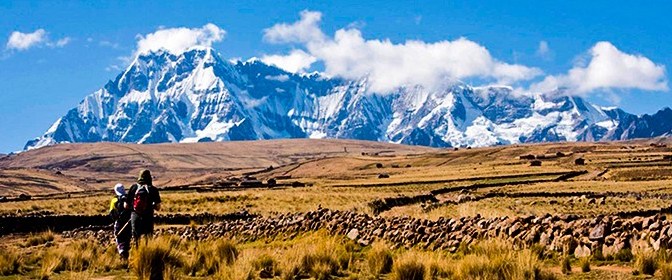
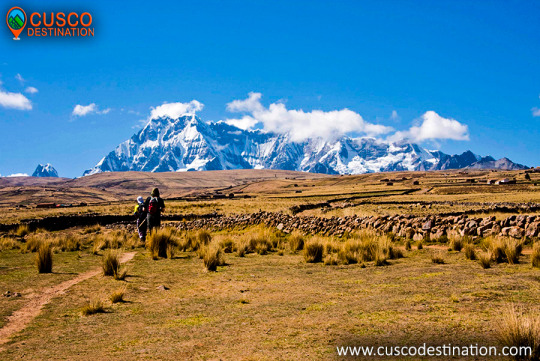
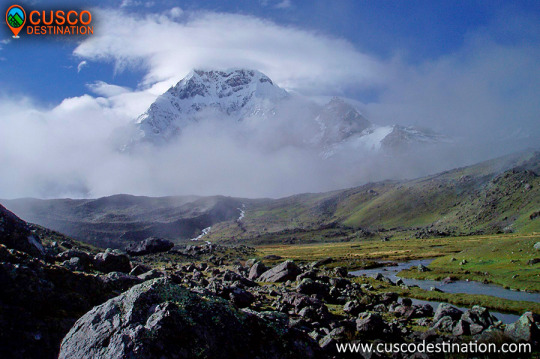
Vilcanota mountain range (Andes), in Peru, with an altitude of 6,372 m above sea level. It is located about 100 kilometers southeast of the city of Cusco. AUSANGATE TREK INFORMATION
Basic information
Relief unit: Andes
Country: Peru (South America)
Main summit
Region: Peruvian Andes
Altitude: 6,372 m
Latitude: 13 ° 47 ’18’ ‘S
Longitude: 71 ° 13 ’40’ ‘O
Every year, hundreds of mountaineers visit the Andean region of Peru. However, not many are aware of the existence of Ausangate, one of the Inca divinities of 6,410 meters high.
Located near Cusco, the “mountain of seven colors” is the fifth highest peak in Peru. Its remote existence from traditional routes means that few tourists approach its walls and glaciers; However, it is worth visiting for its unmatched beauty.
During the Inca Empire, Ausangate embodied one of its most important divinities. Distinction that still lasts; since, the inhabitants who live in the surroundings continue to consider her as an unreachable and sacred god.
The moderate difficulty of ascending the mountain and the possibility of living a unique experience outdoors, make visiting Ausangate a relevant option.
How to get?. Ausangate is located about 100 kilometers southeast of the city of Cusco. Leaving the city by car, the estimated travel time is 3 hours. Upon arrival in Chilca, you have to continue walking for another 3 hours, approximately, until you arrive at this formidable mountain of colors.
For tourists who do not have their own vehicle, there is the possibility of hiring a tour from the city of Cusco, or renting a private vehicle from Thrifty, one of the leading companies in the business.
Ausangate is the representative mountain of the Andes of Cusco and Peru. It is located in the Vilcanota mountain range and is one of the most difficult areas to enter and that is very rare in Peru. Its main climate is 6,372 meters above sea level with large lagoons with a bright green / blue color. In addition there are rocks that make the area like a paradise and very modern. The Trek Ausangate is an indescribable adventure, and it is impossible not to be impressed by the enormous beauty of eternal snow. Often you will find stones at a height of more than 5000 meters and also rocks covered with ice tongues that when thawing, extending in magnificent ways forming ice lagoons. The Ausangate trek is one of the tourist destinations in Cusco. AUSANGATE TREK INFORMATION
In the Inca mythology of this mountain and the nearby lakes – among which Sibinacocha stands out – the male energy is born that fertilizes the mother earth Pachamama, after a long flow, the waters are lost in the unknown lands of the Amazon to return, to fill the lakes and glaciers every night turned into the river of stars or Willkamayu known in the west as the Milky Way The Community of Chillca made up of shepherds of llamas and alpacas is known as the guardian of these pristine places, from where it can be done mountain walks spending the night in comfortable hostels or tambos, among which Machuracay Tambo stand out, in a trek called “Camino del Apu Ausangate”.
Every year on the north side of Ausangate the feast of Quyllur Rit’i (Quechua: “star snow”) is celebrated before the feast of Corpus Christi, during which thousands of Quechua pilgrims to the Lord of Quyllur Rit’i in the church from Sinakara. Snowy Ausangate normally takes a 7-day tour, it is an adventure that no one should miss.
The Nevado Ausangate is a natural attraction that is located in the Ocongate district, within the Quispicanchi province, in the department of Cusco. That snow-capped mountain is part of the Vilcanota Mountain Range and, according to an ancient legend, was the brother of the snow-capped mountain of Salkantay.
Nevado Ausangate, has a height of 6,384 meters above sea level; and it is considered an apu, or protective deity of the towns that surround it; as well as the most representative mountain in the region. Its size is such that it can be appreciated even if one is in the Sacsayhuamán Fortress, not in vain is it considered the fifth highest mountain found in Peru.
This beautiful snowy Cusco, impresses the eye, for its incredible natural formations; in that one not only are beautiful mirrors of water like the Sivinicocha, of turquoise waters, but also forests of stones, glaciers and high plains that seem to make this natural attraction a paradise on earth, especially for those tourists who are interested for adventure sports since the geographical features of Ausangate make it ideal for practicing sports such as rock climbing, ice climbing, trekking, among other activities.
The Nevado Ausangate is presented before our eyes as a mountain challenge; It is known that the first attempts to ascend it took place at the beginning of the fifties of the last century, there were two the first unsuccessful attempts to conquer the top of the powerful Apu, it was not until 1953, when a German expedition achieved the goal, Climbing the mountain on its southern slope, in posterity, new routes were opened for the conquest of the Apu, however, only in 1983, thirty years after the first ascent, Peruvian feet crowned the top of the majestic snow-capped mountain. AUSANGATE TREK ROUTES CUSCO – PERU
Huchuy Qosqo is located in the peasant community of the same name, just under 5 km from the city of Calca in the department of Cusco, in the Sacred Valley of the Incas; exactly at a summit at 570 m. over the Urubamba river basin (Vilcanota). The Huchuy Qosqo route is very beautiful; walking its trails will allow you to visit some Andean communities, archaeological centers and enjoy beautiful landscapes. Many people take advantage of visiting Huchuy Qosqo on their trip to Machu Picchu. HUCHUY QOSQO TREK TO MACHU PICCHU
What does Huchuy Qosqo mean?
Huchuy Qosqo means “Little Cusco”, but it also has other names; one would be Qaqyaxaqixawana and the other Qaqyaqhawana, this means “from where the rays are observed”; and without a doubt it is a good name since being 800 meters above the Sacred Valley of the Incas, gives you the opportunity to see the dramatic light and sound show, at the moment when lightning and thunder descend from the sky to crash into the ground. Others say that the site was probably known in Inca times as “Caquia Jaquijahuana”.
Huchuy Qosqo Archaeological Complex (Qaqyaqawana)
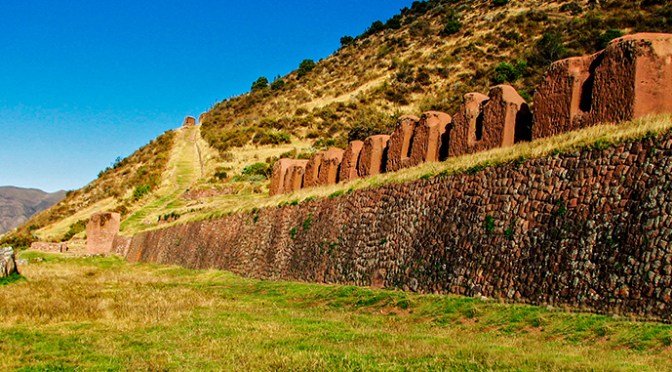
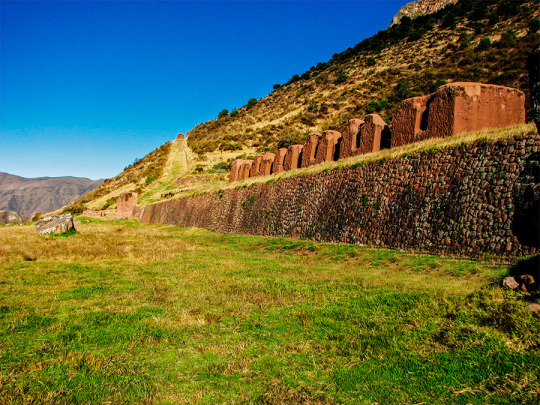
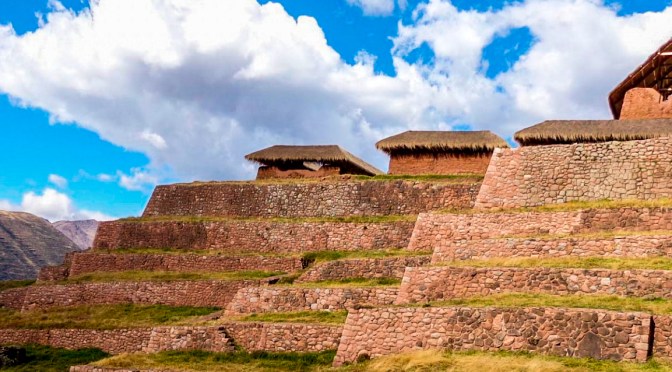
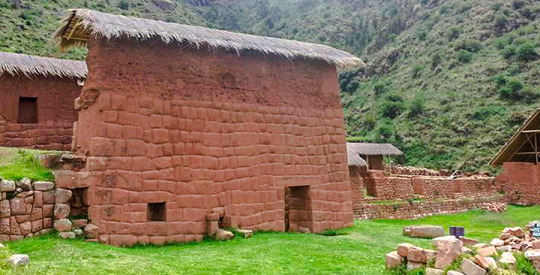
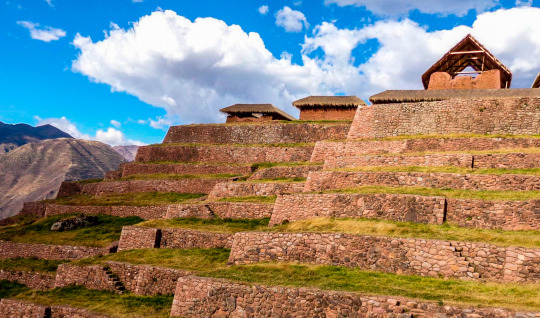
The compound located in Huchuy Qosqo, is called Qaqyaqawana; Quechua name that refers to the place where the lightning is seen. This archaeological site is located in the upper third of the mountain called Qaqya (thunder), and exhibits one of the most impressive topographical modification works through the use of andenería, modulating the edges of precipices and vertical ravines over the Vilcanota Valley, culminating on platforms that were used as ceremonial esplanades, around which several architectural structures made of stone and adobe can still be found standing. Materials used and worked with great judgment, achieving a fine finish.
In addition, the structures of the enclosure are distributed in such a way that they architecturally resemble the city of Cusco; it is for this reason that at the beginning of the 20th century it receives the name of Huchuy Qosqo (small Cusco). One of the most outstanding characteristics of this archaeological site is the use of lithic material combined with adobe and clay. This shows the knowledge and mastery of the different construction materials, used with high technology, especially adobe; The centuries-old walls built of this material still defy the strong inclement weather of the area, seismic movements and of course the passage of time.
This complex is the most important archaeological center in the Urubamba valley, after Ollantaytambo and Pisac. The ruins are impressive, although the conservation of the site is inferior to that of Ollantaytambo or Pisac, because they are older.
But unlike the aforementioned places, Huchuy Qosqo has a peculiar architecture: the buildings have been built on polished stone bases with a fine finish, with clay plaster (they are the best preserved parts) and the highest floors are made of adobe. INFORMATION OF HUCHUY QOSQO TREK
A kallanka (rectangular enclosure that could measure up to 70 meters long and that were important state centers where Inca officials stayed) is observed, at least 40 to 50 meters long. Also a remarkable building with two stone floors and an upper one of adobe. There are also large terraces, a very large plaza and a large Inca gate through which a well-preserved path leads from Tambomachay.
The Hispanic chronicles refer that Huchuy Qosqo (probably a site known in Inca times as Caquia Jaquijahuana) was the work and preferred place of the Inca Wiracocha. To this, Maria Rostworoski adds, in her work “History of the Tahuantinsuyo”, that this sovereign established the conquest over the towns of the Urubamba valley and that he chose as his successor his Inca son Urco who, dizzy with power and vices, proved to be totally incapable of ruling. Inca royalty was very confused by this choice and they tried to conspire to impose on another Wiracocha son, Prince Cusi Yupanqui. Social unrest and tension increased every day and to make matters worse, the darkest night fell on Cuzco: the Chancas reached the gates of the capital and were ready to destroy it. It is the year of 1438. Wiracocha abandons the city to his fate and, accompanied by his son Inca Urco, takes refuge in his palaces in the Urubamba Valley, among which was Huchuy Qosqo.
After the Spanish conquest, Gonzalo Pizarro found the mummy that supposedly belonged to the Inca Wiracocha here and ordered to burn it. The descendants of the Inca kept the ashes in a jar that many years later the chronicler Polo de Ondegardo would discover.
Characteristics of the visit
It is possible to visit Huchuy Qosqo in two ways, the first walking from Cusco and Tambomachay along the Inca trail. The other way is going up from the Sacred Valley after crossing the Wilcamayo river (today Vilcanota).
 cusco destination