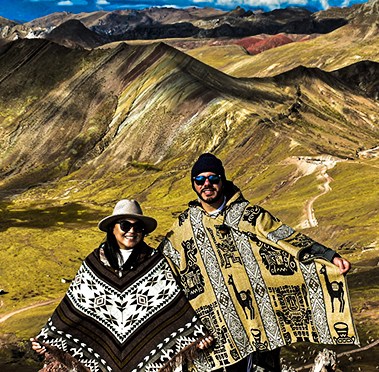
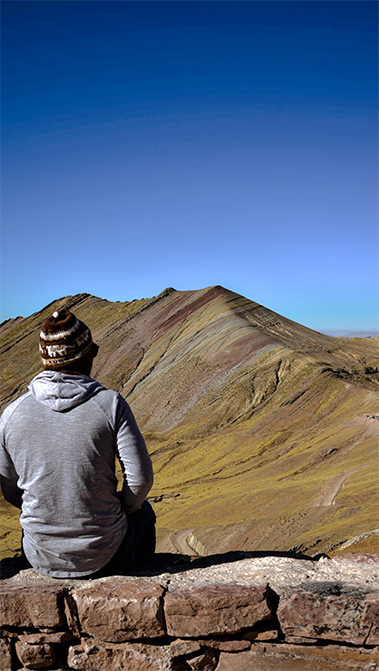
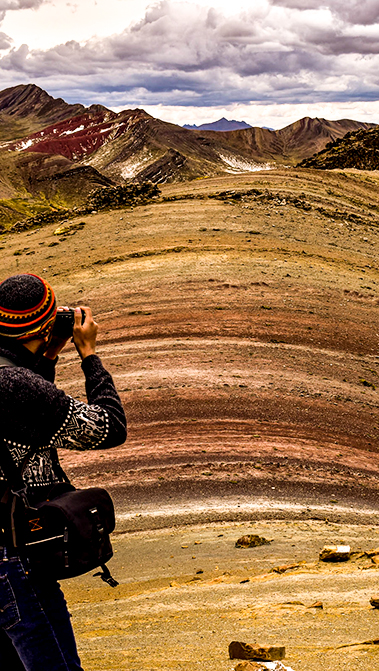
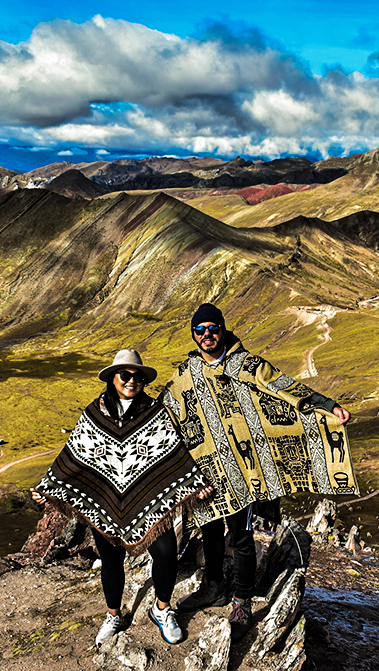
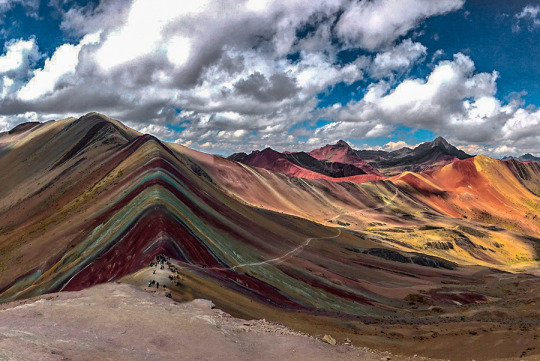
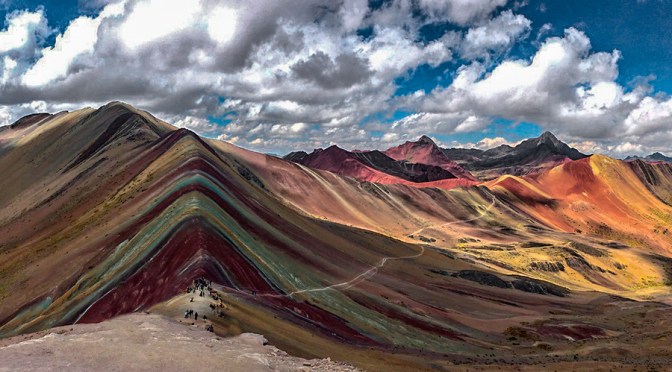
According to the research, the coloration of the rainbow mountain is due to the composition of minerals that it has: the pink color is for the red clay, fangolitas and arilitas. The whitish, for the quartzose sandstone and marls, rich in calcium carbonate. The red is composed of the clay (iron) and clays belonging to the upper tertiary. The green is due to the compound of phyllites and clays rich in ferro magnesian. The earthy brown is a product of fanglomerate composed of rock with magnesium belonging to the Quaternary era. And the mustard yellow color for the calcareous sandstones rich in sulfur minerals, the vinicunca mountain is rich in all these minerals. RAINBOW MOUNTAIN INFORMATION
Useful Information
– Starting Altitude – 3800m / 12,467ft..
– Highest Altitude – 5000m / 16.404ft.
– Meals – 2 breakfast, 2 lunch, 1 dinner
– Overall Difficulty – Moderate
– STARTING POINT: – Cusco at your hotel
RAINBOW MOUNTAIN ITINERARY
DAY 1: CUSCO – OCONGATE – UPIS
This first day we’ll leave Cusco very early for our three-hour trip in a private vehicle to the small village of Tinqui (3,800 meters). We will go by beautiful landscapes and several traditional villages as Urcos, Cattca and Ocangate. In Tinqui we will have lunch, after lunch we begin to walk through beautiful mountain landscapes with great views of Mount Ausangate. We walk for an average of 4 hours to reach the hot springs in Upis (4400 meters). In this place we will have dinner and spend the night.
DAY 2: UPIS – PUCA COCHA
After breakfast, we head to the first pass called the Abra Arapa (4850 meters). After passing the Abra we will have lunch, After lunch we continue on to Lake Pucacocha- a blue lake and a perfect stop for a break. Along the way you will see local herders and llamas, Ausangate mountain to your left, and you will have your expert guide explaining the history of the locals and talking about the landscape along the way. If you’re lucky you may see condors and vicuñas at our campsite where you will be surrounded by high mountains and incredible glaciers- watch for the Ausangate glacier crashing into the lake below! As always camp will be set up for you to change and rest your weary legs and dinner will be prepared.
DAY 3: PUCA COCHA — ANANTA
After breakfast, We will start with a steep ascent of Puca Cocha pass. While is partially difficult, this pass boasts incredible views the entire way. The higher you get the more impressive the lake is below and Ausangate mountain sitting directly across from we. Take some time to enjoy these beautiful views. We will have plenty of time to take wonderful and impressive photographs. After conquering the pass we continue through a vivid green valley with llamas grazing everywhere. As you approach our destination for the day we will have camp set up for you to enjoy your surroundings and relax.
DAY 4: ANANTA — RAINBOW MOUNTAIN — Q´ESIUNO — CUSCO
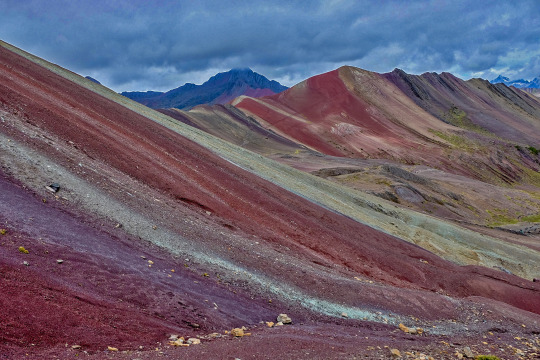
We will wake you up extra early in the morning so you will can be the first people to the top of the Rainbow Mountain. After a hot breakfast, and some coca tea we will start with the first uphill climb- Ananta pass. Here you will see the beautiful Rainbow Mountain in the distance. From here you descend to a large valley and continue walking until we are presented with one final climb to the Vinicunca Mountain. We are going be the first ones at the Rainbow Mountain to enjoy the place at all with plenty of time for photographing, walk around and enjoy the beauty of the area. After we hike downhill for 2.5 hours to Qesoyuno where you have a delicious lunch surrounded by mountains. After lunch the car from the company will pick up us to drive back to cusco for 3.5 hours to take you back to your hotel.
WHAT TO BRING
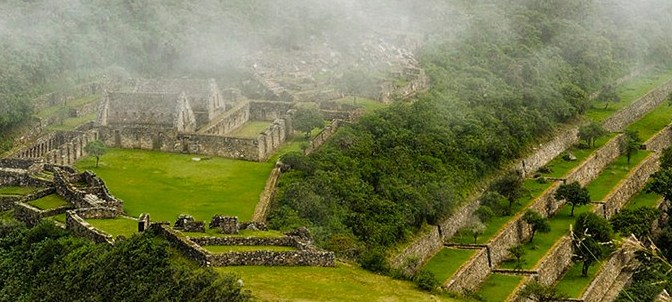
Choquequirao known as the sacred sister of Machu Picchu because it has a structural and architectural similarity, archaeological monuments are made up of terraces distributed on different levels which were leveled and fenced with stones to form a platform with an approximate area of 150 square meters.
CHOQUEQUIRAO TREK INFORMATION
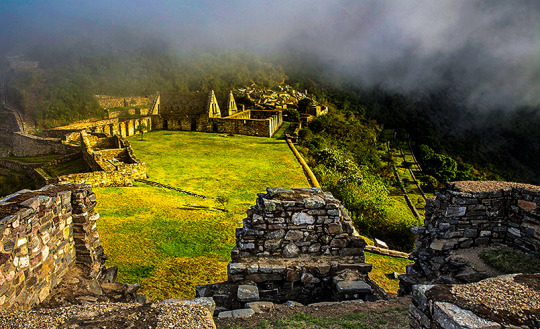
The Choquequirao ruins are located at 13 ° 32 ’latitude and 77 ° 44’ west longitude, it is located at 3033 masl in the mountains of the snowy Salkantay north of the Apurímac river in the district of Santa Teresa province of the department of Cusco.
Currently to reach the last Inca fortress is the land route, the best known route of how to get to Choquequirao is by taking the road to Abancay, and at km 154 choose the detour that will direct you to the town of Cachora.
The route to Choquequirao has narrow paths which must be walked very carefully, also have a good physical condition and the proper equipment for this trek.
Due to its height, Choquequirao enjoys a temperate climate. However, it should be noted that the Choquequirao path is warm due to the Apurímac canyon.
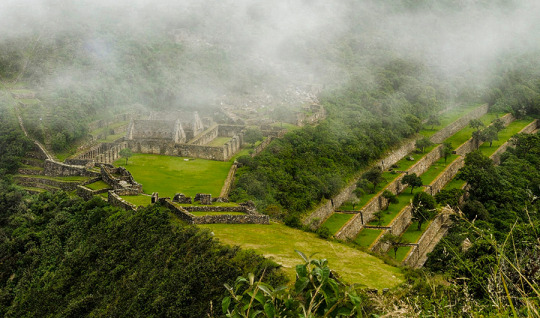
Choquequirao (comes from the Aymara words chuqui, gold, and from Quechua k’iraw, cradle, that is to say: “cradle of gold”), is another of the archaeological zones also known as the Inca citadel, it is located between the ramifications of the Nevado de Salcantay, southern Peru. These archaeological remains of Choquequirao are made up of a set of buildings and terraces distributed on different levels, from the lower Sunch’u Pata level to the highest truncated summit, which was leveled and fenced with stones to form a platform with an area approximately 150 square meters.
Choquequirao (sometimes also referred to as Choqequirau or Choquekiraw), is also known as the “sacred sister” of Machu Picchu for the structural and architectural similarities presented with it. Well, not too long ago it became known about this majestic place, thus awakening the interest of many tourists and researchers.
The environment of Choquequirao is one of the richest in biodiversity, biologists, ecologists and experts mention this, however in this area, the number of species of plants and animals that exist is not known exactly, despite this deficiency and From the few scientific studies carried out, it has been possible to determine the existence of various life forms.
Among the most relevant species are: the condor, the fox, the skunk, the puma, the spectacled bear, the taruca, the vizcachas, the pica pica, the tall toucan, the quetzales and the tigrillos. All these species have been conditioned despite the temperature variations such as the sun throughout the day and the inclement frosts at night. This space can also be seen to the cock of the rocks, Peru’s national bird.
The flora of the place is made up of giant ferns and a great variety of orchids, where the wakanki variety stands out. At the bottom of the great valley and under the thermal effect of the water course that runs through it, the forests of the mountain eyebrow provide their warmth and ideal conditions for a huge variety of crops of coca, annatto, corn, cocoa, coffee and fruit trees.
From the environmental point of view, the main value of these presented ecosystems resides in the role played by the exuberant forests that grow in the high parts of the mountains for the maintenance of the water balance of the region, capturing the rainwater and leading it without causing erosion towards the Apurimac River. MORE INFORMATION OF CHOQUEQUIRAO TREK TO MACHU PICCHU
Andes (South America)
Vilcanota mountain range (Andes), in Peru, with an altitude of 6,372 m above sea level. It is located about 100 kilometers southeast of the city of Cusco. AUSANGATE TREK INFORMATION
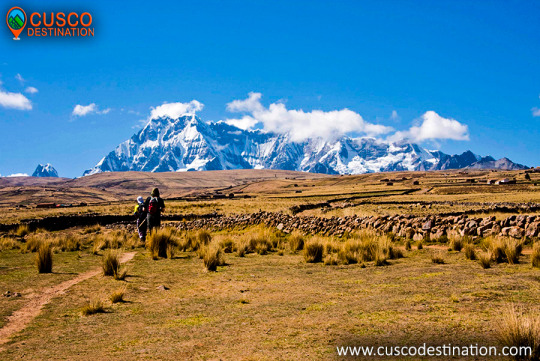
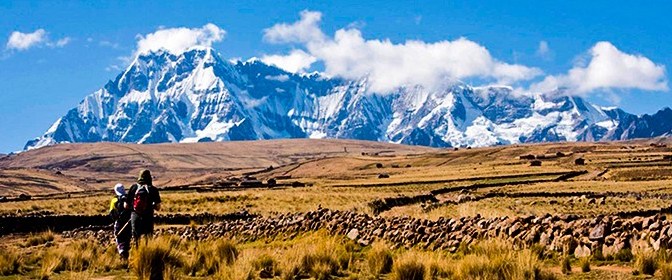
Every year, hundreds of mountaineers visit the Andean region of Peru. However, not many are aware of the existence of Ausangate, one of the Inca divinities of 6,410 meters high.
Located near Cusco, the “mountain of seven colors” is the fifth highest peak in Peru. Its remote existence from traditional routes means that few tourists approach its walls and glaciers; However, it is worth visiting for its unmatched beauty.
During the Inca Empire, Ausangate embodied one of its most important divinities. Distinction that still lasts; since, the inhabitants who live in the surroundings continue to consider her as an unreachable and sacred god.
The moderate difficulty of ascending the mountain and the possibility of living a unique experience outdoors, make visiting Ausangate a relevant option.
How to get?. Ausangate is located about 100 kilometers southeast of the city of Cusco. Leaving the city by car, the estimated travel time is 3 hours. Upon arrival in Chilca, you have to continue walking for another 3 hours, approximately, until you arrive at this formidable mountain of colors.
For tourists who do not have their own vehicle, there is the possibility of hiring a tour from the city of Cusco, or renting a private vehicle from Thrifty, one of the leading companies in the business.
 cusco destination