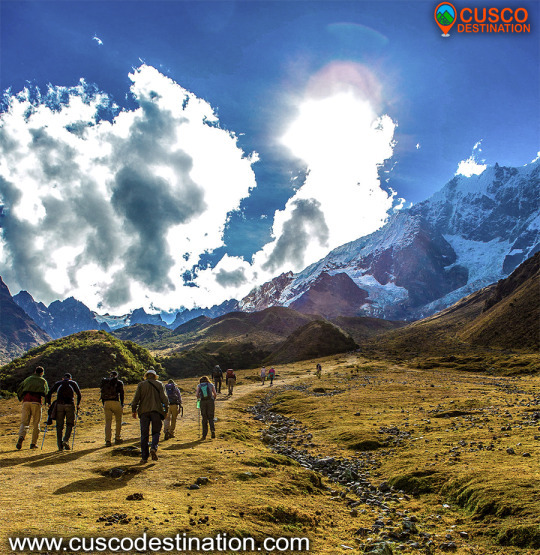
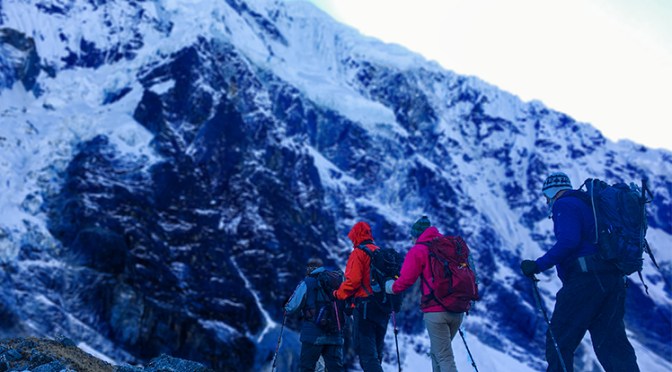
The Salkantay Route, also known as the “New Inca Trail”, is located north of the city of Cusco, following the Cusco – Limatambo – Abancay – Lima road, making a detour between Limatambo and Mollepata.
Salkantay snowy climate:
It is very sunny during the day, but cold at night. The temperature drops below 0 ° C at night during the months of June to September. In the season from December to March it is very rainy so it is not recommended to go on these dates.
The best time to do this trek is during the months of March to September.
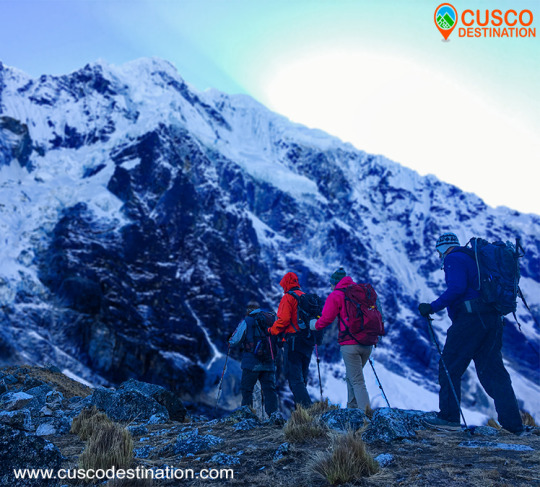
This hike reaches a height of 4,600 meters above sea level at its highest point is on the slopes of the same snowy Salkantay. Enter Ausangate 5D Snowy Walk to do this little walk.
How to get to the snowy mountain of Salkantay
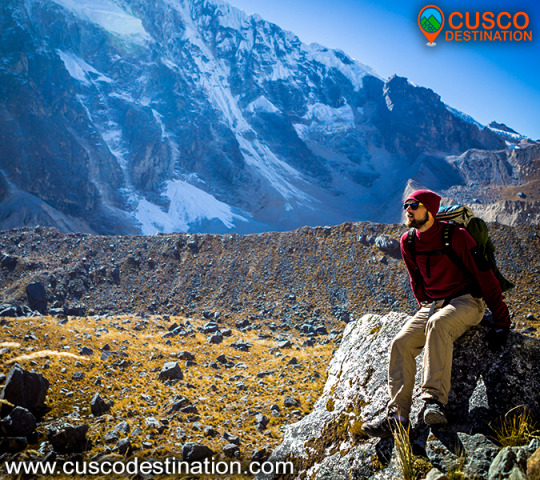
The buses from Cusco to Mollepata leave very early from 4 am to 5 am and pass through Limatambo, from Mollepata is where the trek to the snowy Salkantay begins, after climbing a step it is possible to have an impressive pyramidal view of Salkantay, one of the mountains most beautiful snowfall of Cusco.
From Mollepata it takes two days to descend to Huayllabamba and join the second day of the Inca Trail.
What you will see along the way
On the way you can see herds of cattle and sheep, orchids, bear with glasses, medicinal plants of the Inca eponca, small variety of birds, fruit trees such as orange, papaya, bananas, and so on.
Note: The eye of the glasses to see it is necessary to have some luck.
recommendations
It is very important for the traveler. Bring your original passport for the respective controls.
RECOMMENDED MONTHS TO TRAVEL
March: (a little rain)
From April to October: (an excellent trip)
From October to November: (a little rain)
December to February: (lots of rain)
Note: There is, in my opinion, a controversy regarding the paternity of the first ascent of this crest S.E., since it consists in the previous realization of a powerful group of Japanese who achieved the ascent by this route. Unfortunately, the only reference found in this Japanese ascension dates from an Iwa magazine to Yuki, written, of course, in Japanese, so without a translation of the text there is no concrete data.
The western edge of the Salkantay is a route that remains virgin after years given the complexity of its layout and the distance from the traditional approach points, which requires additional porting based on the dragging of backpacks.
According to the prestigious Pyrenean Louis Audoubert, who ascended to the top by the northern slope in 1977, the west edge is feasible, but it will certainly be a good problem to solve at the Andean level.
This crest was attempted in 1975 by a group of Catalan climbers from Mataró formed by Manuel Punsola and Mitjans, Miquel Sala and Roy, Xavier Varela and Pinart, Ramón Armengol and Carbó, Antoni Sors and Farre, Antoni Rosa and Olivera and Vicente Aris and Julta .
On August 5, 1975, three members of this expedition approached the edge by an additional buttress of the northern slope that had been previously recognized. They go up for a good part of the day until they reach a point with two possibilities that seem unattainable. The logic was to tackle the ice ridge, something impossible given the lack of material means. The other option would be to flank the slopes of the ridge to look for the hill between the two Salkantay peaks.
At a certain point of this great flanking, which they calculate, it will take them a whole day, they decide to leave due to the large number of avalanches that leave the ridge and that are obviously a first order objective danger. Catalan climbers believe that the difficulties so far have not been important or dangerous, but moving away from the obvious route of the ridge, which would require more human and material equipment, greatly increases the risk.
Coming from Mollepata the first vision we will have of Salkantay is in its overwhelming south face a huge wall that closes the bottom of the valley with its vertical seracs hanging from huge rocky spurs, this wall could not fail to attract the attention of those who try to complicate a little their lives for pure personal satisfaction, so in 1970 a powerful group of Germans from the Munich DAV composed of Walter Welsh, J.Vogt, H.Koebrich, H.Haver and M.Olzowy made a meritorious attempt on the left side of the wall, leaving quite high on the crest that descends to the western summit of Salkantay.
In 1986 an English group led by J.Lowe broke through this hillside attacking the rocky base to the right of the German attempt of the 1970s. The snow zone continued a slight diagonal to the right until it reached the eastern peak of the mountain.
On June 15, 1978, a powerful Slovenian expedition of the Planinska Zveza, composed of Libor Anderle, Zoran Breslin, Marjan Brisar, Edi Torkar, Jure Zvan and Jure Ulcar, accompanied by Dr. Borut Pirc and Matjaz Derzaj as coordinator, opened in a week Exploring and climbing an intelligent route along the eastern slope of the mountain, the Slovenian route, which without detracting from the difficulty, is the most feasible option of trying to reach the top.
The second ascent to this route was made by the Mexican Roberto Morales Puebla and companion on June 17, 1978 and the third by Los Vascos de San Sebastián, Iñígo and Jesús Mª Barandiarán, José Luís Conde and Jesús Mª Rodríguez accompanied by Alberto Cabezón and José Antonio Fernández de Aranguiz on July 3 of the same year, which makes it the first ascent of mountaineers in the Spanish State.
The Salkantay has been visited by mountaineers from around the world, French, Swiss, North American, New Zealander, Polish, Austrian, German, Mexican, Slovenian, Slovenian, Spanish (Asturian, Basque, Andalusian, Catalan)…. that have crossed its steep slopes… some lived the light of the reward from the top … others, a great majority, had to withdraw when the chance of triumph among the cornices escaped.
Also known as Salkantay, Peru’s snowy peak located in the department of Cuzco, it is one of the main elevations of the Vilcabamba Range, an extension of the Eastern Cordillera, a mountainous branch of the Peruvian Andes. It reaches an altitude of 6,271 meters. It has two snowy peaks, known as China Salkantay and female Salkantay, separated by a port that opens to the Santa Ana Valley in the province of Urubamba. Both the mountain pass and the course of the river that is born there are called Salkantay. This river pours its waters into the Urubamba on its left bank.
Our company has the Salkantay Trek, a walk that will take you to Machu Picchu.
Hence the name of Snowy Salkantay:
The name of this mountain is a contraction that comes from Salga = sullen or wild and Antay produces bees or avalanches. It is usually preceded by the name of Apu, which in Quechua language comes to mean sir, is defined as large mountains that mean something sacred above the valleys. For example, Apu Salkantay in the Vilcabamba mountain range.
The great white Apu. A little stories between ropes and crampons:
The Salkantay is one of the highest mountainous regions of the Qosco (Cusco). The highest mountain is the Gran Agusánate with 65 meters more in the Vilcanota mountain range located further south. However, and without a doubt, it is the greatest in its splendid isolation and in the greatness of its double-headed massif, to which is added the fact of being one of the mountains of this magnificent Andean region that presents greater technical problems for all its slopes This is evidenced by the six itineraries opened to date by the different slopes of this white giant.
His conquest dates from 1952 by the Swiss cordate composed of Bronimann and Marx.
This first ascent, like so many others in the history of mountaineering, is involved in several contradictions, since a few days later it is promoted again by a Franco-American expedition that included the well-known and relevant mountaineer of the Claude Kogan era.
Modern statistics merit being the first woman on top of the Italian Consuelo Bonaldi who climbed Cresta Este on August 4, 1978 accompanied by G.Marconi, A.Monononi, F.Nodari, S.Castellani, Augusto Zanotti and M.Quatrinni, obviously this is a mistake, since Claude Kogan did it 26 years before.
The Salkantay summit has two peaks, the East and the West, formerly the West, more slender and attractive than the East, which was slightly taller because it was crowned by a seracoa. After the passing of the years and the collapse of this serac, as the prestigious Pyrenean Louis Audoubert has pointed out, the height is practically identical in both peaks.
What happened in those two consecutive “first ascents” gave rise to the controversy that it had really been the first real one.
The Swiss went up in the fog to the top of the East (the lowest in those days), the Americans however went up to the West, which was somewhat higher so the statistics, always relentless, want to deny Bronimman and Marx his first absolute ascension.
In 1953 he was climbed for the third time by the prestigious Alpine guide Lionel Terray, who together with the Dutch T. de Booy and the Swiss Raymond Jenny defeated the summit following a route along the northern ram, now known as the Terray Ram.
Years later, a German expedition tries the top following the dangerous crest of the N.E. which, with its cornices, does not favor traffic … a relevant rope formed by Tony Mazenauer and Fritz Kasparrek (the latter conqueror of the north face of the Eiger) disappears on this ridge and the expedition has to be withdrawn.
Today there is a plaque commemorating that unfortunate event under the passage of Palcay (the usual base camp of the mountain) and on a block of visible rock.
On August 23, 1975, it was the turn of a long and steep crest of the S.E. of an Australian-New Zealand expedition composed of Peter Jennings, Wayne Barton and Michael Andrews. This ascent was the ninth to the top.
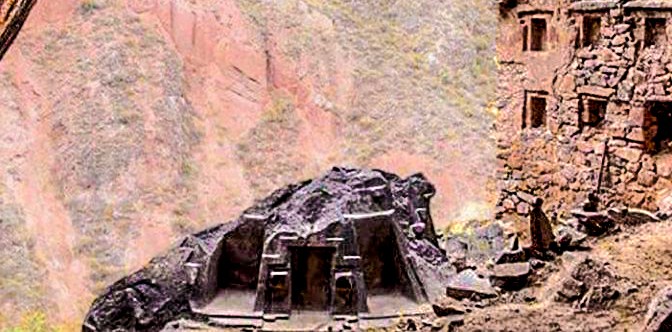
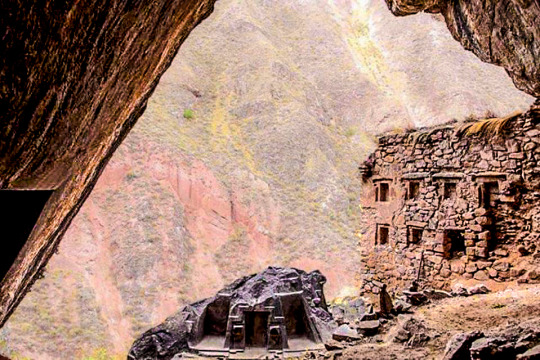
This place was dedicated to the extraction and carving of the stones that were used for the construction of Ollantaytambo and many surrounding precincts. This place is located about 14 km from the Inca town of Ollantaytambo and has three groups of quarries: Molle Pucro, Sirkusirkuyoc (it was the largest of the three), shows the evidence of having been fully operational when the Spanish arrived in this area . And finally Cacchicata or Kantirayoq, where another type of extraction of minerals and precious stones was practiced. Visitors can observe the great work done at the time of moving the giant stones to build Ollantaytambo enclosures. We can find the stones called “Tired Stones” that were on their way to Ollantaytambo and in some parts of the city.
Cachicata or Inca quarry is one of the old quarries used by the pre Inca and Inca civilizations to build the vast complexes of Ollantaytambo. It was a source of large amounts of pink granite. Cachicata quarries are 14 km from Ollantaytambo. The view of Ollantaytambo from the quarries is spectacular and during the walk you can see many large stones that remained in the middle of their long trip to the village. It was also a commercial route for the Incas. Cachicata is a small and remote town that can benefit from the occasional visit of tourists.
The Hike to Cachicata is a great alternative to the famous Inca Trail hike. This road was built by the Incas and used for hundreds of years to access local communities and transport goods. This trail is not as well known as the Classic Inca Trail, so much less crowds and a more serene trekking experience in Peru are expected. This hiking adventure not only visits Peru’s cultural past, but also explores modern Inca communities and customs. The trail takes us through isolated waterfalls, ancient terraces and exotic wildlife, while offering fantastic views of the Sacred Valley and its snowy mountains. Visit with local families and explore an active quarry. Each step brings a new look to the Inca culture.
How long is Ollantaytambo?
The trip from the city of Cusco to the Inca city of Ollantaytambo is approximately 1 hour and 30 minutes in private mobility but if you wish to travel in the public transport units the approximate time is 2 hours.
Can you climb to the Inca quarry of Cachicata without a guide?
The Walk to the Inca quarry of Cachicata being part of the Inca road circuit that runs through the country of Peru, and the circuit of Qhapap Ñan, it is recommended that it be carried out with the supervision of an authorized agency that provides the professional guide service so that you can enjoy the best way to hike and take a nice memory to your country.
How high is Inti Punku “Puerta del Sol”?
Inti Punku or «Puerta de Sol» is the highest point on the hike to the Inca quarry being at a height of approximately 3886 meters from that point you can see an impressive view of the Sacred Valley and the Snowfall that are around as are the snow Veronica.
What should I take to make the walk to the Inca quarry of Cachicata?
To make the walk without any inconvenience we recommend the following:
A lightweight backpack to carry your stuff.
Water bottle.
Money for snacks, souvenirs and tips if you want to tip.
Hat, sunscreen and sunglasses
Jumper (sweater)
Protection against rain (or plastic poncho) the Cusco region can experience “all seasons in one day”, therefore, it is advisable to wear a hat and gloves, as well as a sun hat, when you go out tomorrow, in order to be prepared for all eventualities.
Is a tourist ticket needed for the Inca Quarry of Cachicata?
At the moment no income is being collected, which will allow you to discover more freely the path of the Incas to the Inca quarries of Cachicata.
 cusco destination